China’s Factory PMI Falls to 49.3 as Export Orders Weaken — Why the Slowdown Matters
· News Team
China’s manufacturing sector lost momentum in October. The official purchasing managers’ index (PMI) fell to 49.3 from 50.1 in September, returning below the 50-point line that separates improving from deteriorating conditions in this monthly business survey. The October figures, published on 31 October 2026 by China’s National Bureau of Statistics (NBS), were independently reported by Reuters and Associated Press.
Factories are receiving fewer orders
The weakness was not confined to the headline figure. The manufacturing production index dropped to 49.8 from 51.7, while the new-orders index declined to 49.4 from 50.5. New export orders slipped from 50.0 to 48.7, suggesting softer overseas demand alongside pressure in the domestic market. These are survey indicators, not counts of goods produced or exported.
The slowdown was uneven. The NBS reported a PMI of 50.2 among large manufacturers, compared with 48.4 for medium-sized firms and 47.5 for smaller businesses. This divergence suggests smaller producers may be experiencing more pronounced weakness, although a single month does not establish a lasting trend.
What does a 49.3 PMI actually mean?
A PMI is a diffusion index compiled from purchasing managers’ assessments of business conditions. A reading below 50 means that, on balance, conditions worsened compared with the previous month. It does not mean that factory output or China’s GDP contracted by 0.7%, and it should not be treated as a direct forecast of recession.
September’s brief move back above 50 therefore appears to have been short-lived. Reuters cited softer demand and the earlier timing of some export orders as potential contributors, while AP highlighted the pressure created by China’s subdued domestic market and trade tensions. Neither explanation, on its own, establishes that a particular tariff or policy caused the October decline.
The slowdown reaches beyond manufacturing
The NBS non-manufacturing business activity index also fell, to 49.7 from 50.2. Construction activity registered 48.0, while the services index was 50.0. The broader composite PMI output index declined to 49.7 from 50.7. Taken together, the readings suggest weakening short-term momentum across several parts of the economy, though they remain survey-based measures.
Why the world is watching
China supplies machinery, components and finished goods to markets around the world. Weaker orders may influence manufacturers’ inventory decisions, investment plans and pricing. But the PMI cannot tell us by itself how global shipping volumes, company profits or consumer prices will change. Conditions also vary by industry: the NBS said activity in several transport and technology-related service sectors remained comparatively strong.
The next tests will be whether export orders recover, whether smaller manufacturers regain momentum and whether subsequent figures on industrial output, international trade and household spending confirm the survey’s warning. October’s report signals a loss of momentum, not proof of an economy-wide contraction.
Sources and reporting notes
- National Bureau of Statistics of China, official October 2026 PMI release (31 October 2026) — primary data and methodology.
- Reuters, 31 October 2026 — independent reporting and economic context.
- Associated Press, 31 October 2026 — independent reporting and trade context.
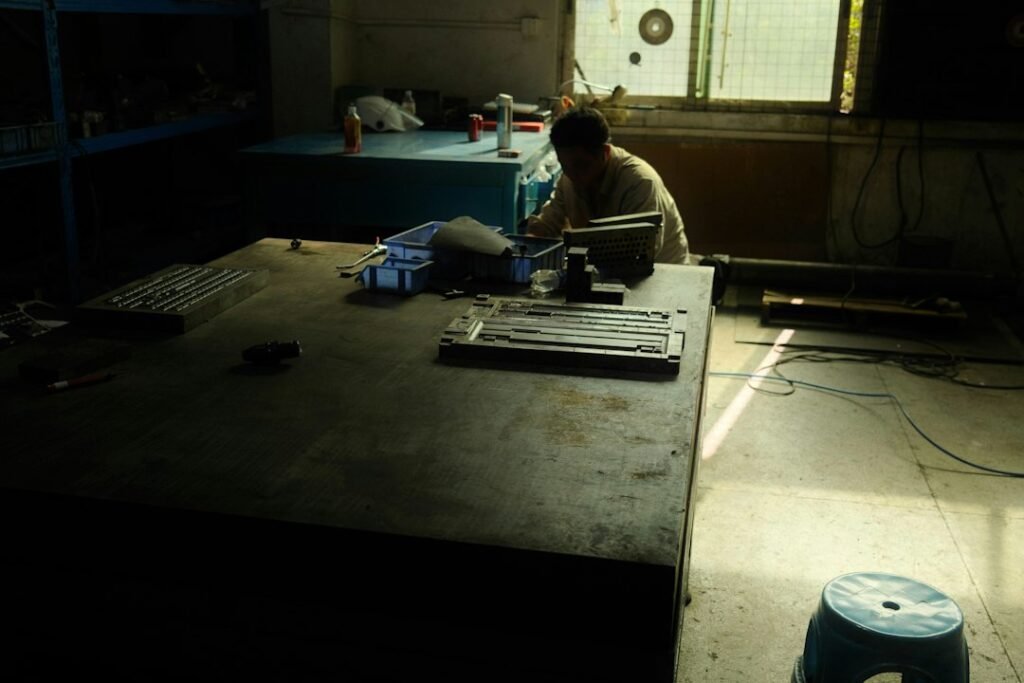
Image: Illustrative factory tooling photograph by Tim Kelly / Unsplash (Unsplash License). It does not depict the October 2026 PMI survey or establish conditions at any specific factory.


About The Author





Leave a Reply