Serbia Election: Vučić Concedes as Student-Backed List Leads Projections
· News Team
Latest update: Vučić concedes defeat; student-backed list leads projections
Updated October 26, 2026, shortly after midnight CET (October 25 election night in Serbia). Aleksandar Vučić acknowledged that his political list lost Sunday’s parliamentary election to the student-backed Student List. Speaking after polls closed, he said projections suggested the Student List would take 135–140 seats in the 250-seat National Assembly and his list about 105 seats. Reuters and Associated Press independently reported his concession.
Separately, an Ipsos/CeSID election-night projection reported approximately 52% of votes and 138 seats for the Student List, against 39.3% and 104 seats for Vučić’s list, based on a sample of polling stations. These are projections, not certified results; vote shares and seats may change as the count progresses. See election-night reporting citing CeSID/Ipsos and consult the Republic Electoral Commission’s official results portal for published official figures. We could not independently establish a complete certified national tally from the commission’s public results display at the time of this update.
What happens next: A projected parliamentary majority does not itself install a government. The electoral authorities must complete their process, seats must be confirmed and the incoming parliament must convene. The key questions are whether the projected result holds and how institutions manage the transition.
Election-night video
Watch Sky News coverage of the concession and celebrations in Belgrade (October 25). This is a link to the broadcaster’s own reporting, not a locally hosted or embedded video; availability may vary by region.
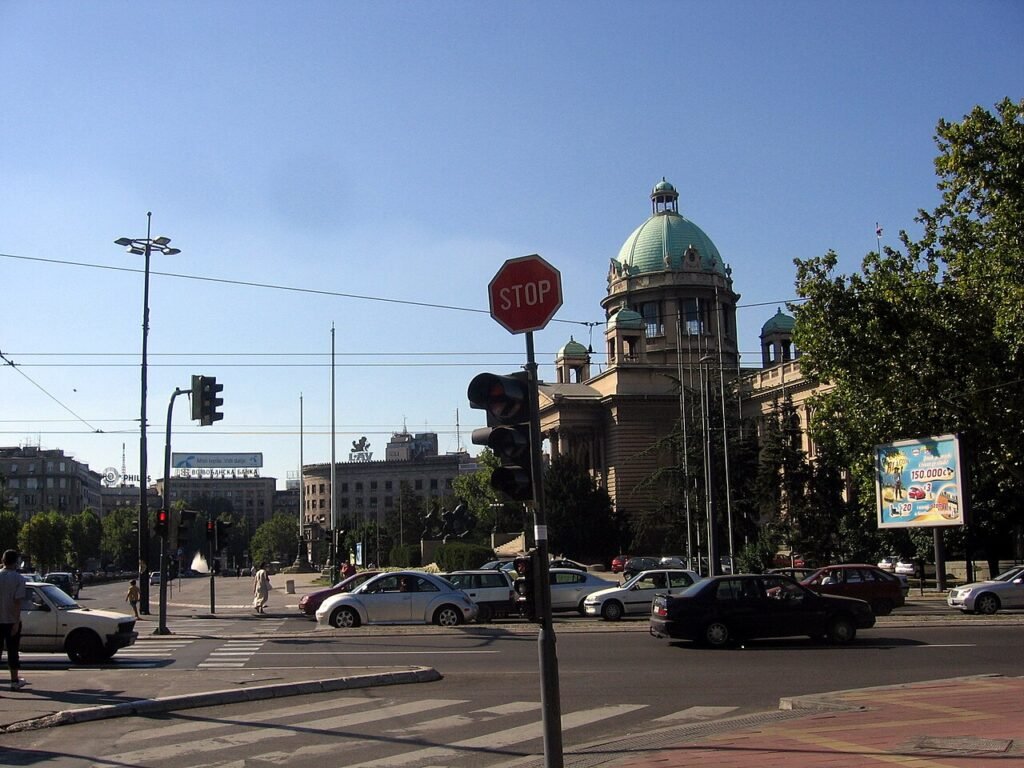
Photo note: The featured photograph is an archival view of the National Assembly building, not a photograph of the election-night concession. Credit and licensing details appear below.
Original election-day guide (archived context)
The following section was written before polls closed on October 25. It is preserved for background and should be read alongside the newer election-night update above.
BELGRADE, October 25, 2026 — Election-day guide, prepared before polling stations opened. Serbia is holding an early parliamentary election today, with a student-backed political movement challenging the party long associated with Aleksandar Vučić. The contest comes after nearly two years of demonstrations demanding accountability and institutional reform.
Voting is scheduled from 7:00 a.m. to 8:00 p.m. local time, according to Serbia’s official voter information service. Update — October 25, 2026, midday local time: Reuters reported turnout of 27.3% by 11:00 a.m., compared with 15.1% at the same point in the 2023 election. These are preliminary turnout figures, not a result or a forecast of the winner. The Serbian government’s election-day briefing confirms that polling opened at 7:00 a.m. for 6,451,292 registered voters at 8,392 polling stations. See Reuters’ October 25 turnout report. Final vote totals and winners had not been established in this midday update. Follow the Republic Electoral Commission (RIK) for official announcements.
Why this election matters
The protests began after a canopy collapsed at the Novi Sad railway station in November 2024, killing 16 people. Protesters have linked the tragedy to alleged corruption and failures of oversight. The authorities and the governing party dispute accusations of systemic wrongdoing. What began as demands for accountability developed into a wider debate over institutions, public trust and Serbia’s political direction.
For the governing Serbian Progressive Party (SNS) and its allies, the election is a test of whether their record on investment, infrastructure and living standards continues to command support. For the student-backed opposition, it is a chance to turn street mobilization into parliamentary representation. Neither side’s success can be assumed from demonstrations or polling alone.
What voters are choosing
Serbia elects a 250-seat National Assembly. A majority requires at least 126 seats. Local reporting on the electoral commission’s certified lists identifies 18 competing electoral lists, including nine representing national minorities. Seats are allocated under proportional representation rules, so the final balance depends on the nationwide vote and the electoral thresholds and exemptions applicable to different lists.
What the polls can and cannot tell us
Pre-election surveys have pointed to a competitive contest, but estimates differ substantially. One Ipsos poll cited by Reuters put the SNS at 47% and the student-backed list at 40%, while other surveys have shown a different balance. Polls measure opinion at a point in time; they are not election results, and coalition mathematics may matter even if one list finishes first.
Key times and how to verify results
- October 25, 7:00 a.m.: Scheduled opening of polling stations.
- October 25, 8:00 p.m.: Scheduled closing, with eligible voters already waiting allowed to vote.
- After polls close: Look for turnout and results released by the electoral commission. Treat media projections and party claims as provisional until officially confirmed.
Election-day reporting should distinguish allegations from established findings, and projections from official tallies. Any updates to this article should be timestamped and linked to their source.
What comes next
The result will determine the composition of parliament and could affect Serbia’s domestic reform agenda, relations with the European Union and the balance between the governing party and a new generation of challengers. But it will not resolve the country’s political tensions overnight. The immediate measures of the outcome will be turnout, certified seat totals, possible coalition negotiations and the credibility of the process.
Image note: The accompanying photograph, if displayed, is an archival image of Serbia’s National Assembly building—not a photograph of voting on October 25, 2026. Photo: Stebunik / Wikimedia Commons, CC0 1.0 (public domain dedication). Source and licensing.
Sources
- Republic Electoral Commission voter guide: opening hours and voting rules.
- Republic Electoral Commission: official election announcements.
- Reuters, October 25: election context, parties and polling.
- Danas, October 23: certified electoral lists.
For other international developments, see Tectonics World.


About The Author






Leave a Reply