Did Supernova Winds Slow the Universe’s First Light? Hubble Study Reverses an Old Assumption
· News Team
October 30, 2026 — Science. Exploding stars can blow enormous cavities through a galaxy’s gas. It sounds reasonable that these winds would also help high-energy starlight escape into intergalactic space. But new observations suggest the timing may work the other way around: the radiation escapes most readily before the strongest supernova-driven galactic winds develop.
Why the first galaxies needed an escape route
In the universe’s first billion years, much of the space between galaxies contained neutral hydrogen that absorbed energetic ultraviolet photons. As stars and galaxies produced enough escaping ionizing radiation, that gas became ionized, helping end the era often called cosmic reionization. Astronomers have long debated how light could get out of the dense, dusty regions where young stars form.
A study published on October 15 in Nature Astronomy examined six comparatively nearby, compact, star-forming galaxies with Hubble Space Telescope ultraviolet spectroscopy. These are local analogues used to probe physical processes relevant to early galaxies, not direct observations of six galaxies from the dawn of the universe. The team compared the fraction of ionizing light escaping with the ages of stellar populations and signatures of gas flowing outward.
The surprising sequence
In the youngest starbursts—less than roughly three million years old—the researchers found stronger escape of Lyman-continuum radiation, when intense radiation and stellar winds from massive stars were already present but fast, galaxy-scale outflows had not fully developed. In older systems, faster and dustier outflows coincided with lower escape fractions. The authors propose that as supernovae begin driving and loading those winds with gas and dust over the first approximately ten million years, they can reduce the amount of ionizing radiation reaching the wider universe.
That does not mean every supernova blocks light, or that galactic winds never open escape channels. The observational sample is small, the galaxies are nearby proxies, and the proposed physical sequence is an interpretation of measured relationships rather than a controlled experiment. Different galaxies and stages of star formation may behave differently.
Why this matters for models of cosmic dawn
Many models of the early universe must estimate how much ultraviolet light leaves young galaxies. If that escape fraction changes sharply with starburst age, a single fixed value can hide an important part of the story. The study points toward a more time-dependent picture: radiation from the earliest massive stars may reach intergalactic hydrogen efficiently for a short window, while later supernova-driven winds could partly shut that window.
For now, the finding is a testable clue—not a final explanation for how the universe became transparent. Larger samples, improved ultraviolet measurements and comparisons with very distant galaxies will be needed to learn how broadly this pattern applies.
Research sources: Carr et al., Nature Astronomy (published October 15, 2026); University of Michigan research summary (October 30, 2026).
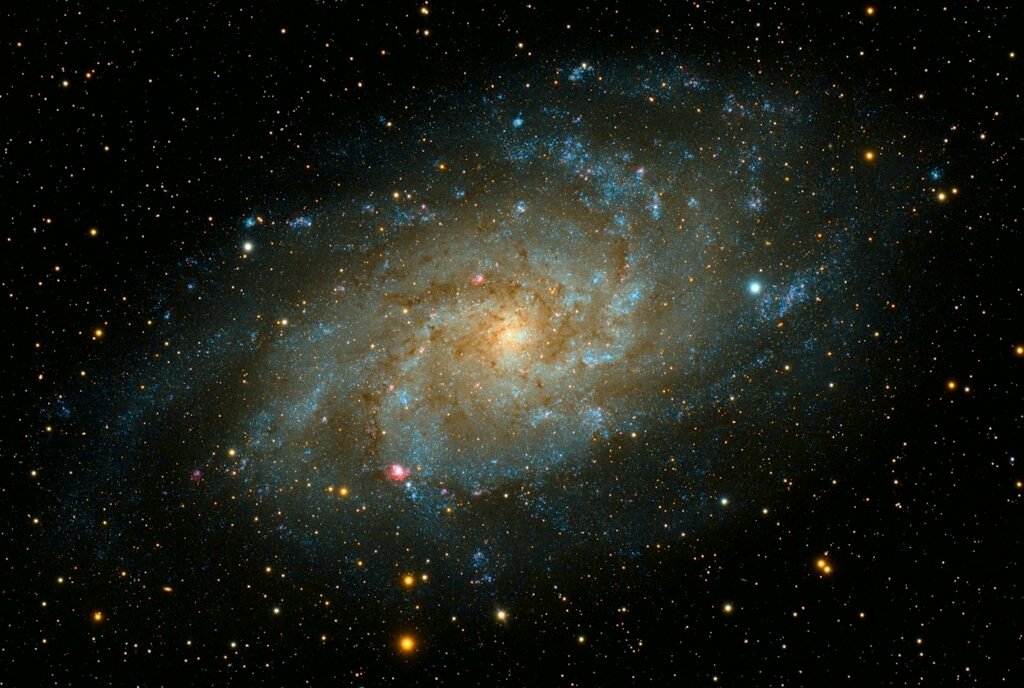
Featured image: Triangulum Galaxy (M33), photographed by Guillermo Ferla / Unsplash. This is a general illustrative astronomy image, not an image of one of the six galaxies in the study. No same-study official video with verified embed rights was found at publication time.


About The Author





Leave a Reply