Musk Says SpaceX Closed $40 Billion in GPU Debt: What Is Verified and What Is Not
· News Team
October 26, 2026 — Reuters reported on October 25 that Elon Musk said SpaceX had closed $40 billion in debt financing to buy graphics processing units (GPUs) for artificial-intelligence computing. The claim is consequential, but the distinction between an executive’s statement and a fully documented financing agreement matters: the lenders, final pricing and full contractual terms have not been independently established in the reporting reviewed for this article.
Musk attributed SpaceX’s ability to borrow to what he described as its investment-grade standing and revenue from Starlink and rocket launches. He said the financing was mainly callable debt for GPU purchases expected to arrive in the first and second quarters of 2027. Those statements are attributed to Musk; this report has not independently verified the company’s credit rating or debt documentation.
Key facts — and what remains unconfirmed
- Claim: Musk said SpaceX had closed $40 billion of GPU-related debt financing on October 25.
- Timing: Musk linked the financing to chip deliveries expected in Q1 and Q2 2027, not necessarily immediate equipment installation.
- Terms: The identities of lenders, interest rates, repayment terms and precise meaning of “closed” were not independently confirmed in the available public reporting.
- Separate number: Reuters reported company guidance of $35 billion–$40 billion in fourth-quarter 2026 capital expenditure. That spending forecast is not the same thing as the newly claimed debt financing.
Why GPU financing has become a major business story
GPUs power much of today’s large-scale AI training and inference. Buying them is only part of the bill: operators also need power, cooling, networking, buildings and enough paying customers to keep costly equipment productive. The scale of the claimed borrowing illustrates how AI infrastructure is increasingly a capital-markets story as well as a technology story.
On October 6, Reuters reported that SpaceX was seeking approximately $40 billion to purchase Nvidia chips. The October 25 statement represents Musk’s account of a later stage of that process; without independent transaction documentation, it should not be treated as independently audited proof of the final financing terms.
What Musk’s warning about ‘neoclouds’ means
Musk also predicted consolidation among so-called neocloud providers — companies focused on renting AI computing capacity. His argument was that operators without significant non-AI revenue could struggle to obtain credit. This is a forecast by an interested industry participant, not an established prediction of which companies will survive.
The central question for investors and customers is whether projected demand for AI computing will justify equipment purchases, financing costs and continuing power expenditure. A large financing announcement does not by itself demonstrate profitable utilization, nor does a warning about competitors establish that they are insolvent.
What to watch next
Independent confirmation from lenders or formal company disclosures would clarify whether the full $40 billion has been committed, drawn or merely arranged, and on what terms. Later updates should also distinguish chip delivery from operational capacity, and track actual utilization and revenue rather than extrapolate from headline borrowing amounts.
Primary statement and reporting
Musk’s October 25 follow-up statement on X describes the timing of planned GPU purchases. See also Reuters’ October 25 report and its October 6 report on financing discussions.
Video: no verified exact-event recording
The announcement reviewed here was made in text posts, and no authorized video documenting this specific October 25 financing statement was independently confirmed. No unrelated interview or stock footage has been embedded. The original statement is available for readers to check.
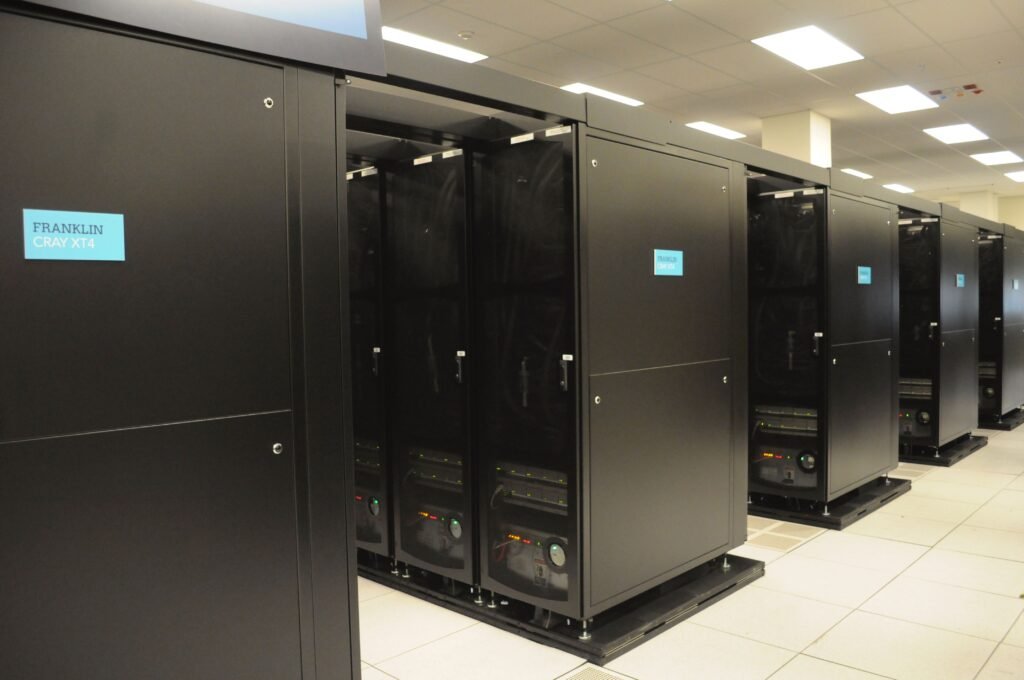
Image credit: Archival photograph of Franklin Cray XT4 computer racks, photographed by Derrick Coetzee in 2011, via Wikimedia Commons; CC0 1.0. Illustrative only: the photograph does not depict SpaceX, Nvidia GPUs or the reported transaction.
Related: How Moonshot says it reduced cyber-offensive capability in an AI model.


About The Author






Leave a Reply