NASA Astronauts Complete 7-Hour ISS Spacewalk — Why the Seventh Solar Array Matters
· News Team
Updated October 29, 2026. Two astronauts completed a 7-hour, 11-minute spacewalk outside the International Space Station on Thursday, deploying a new roll-out solar array that will help power the orbiting laboratory and its eventual controlled deorbit.
NASA astronaut Anil Menon and Canadian Space Agency astronaut Joshua Kutryk ended their excursion at 3:08 p.m. Eastern time, according to NASA’s same-day mission update. The pair installed the seventh International Space Station Roll-Out Solar Array, or IROSA, on the station’s 2A electrical power channel. Kutryk was making his first spacewalk; it was Menon’s fourth.
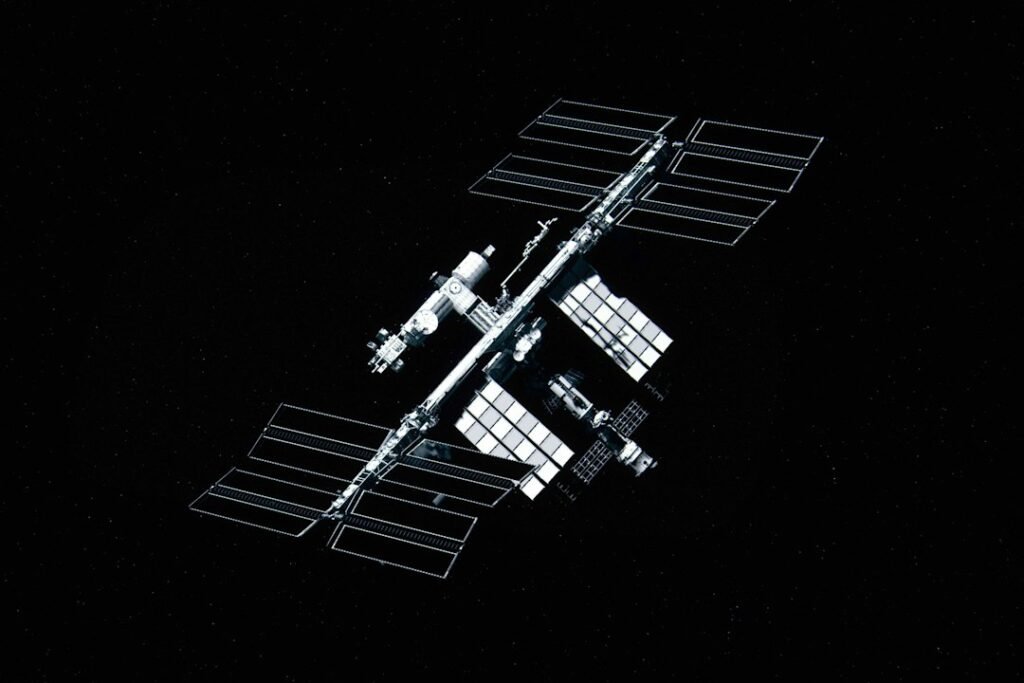
Featured image: illustrative International Space Station photograph by Norbert Kowalczyk / Unsplash; not a photograph of the October 29 spacewalk.
Why one more solar panel matters
The new array is not simply an efficiency upgrade. The station needs electricity for life support, experiments, communications and the systems that keep it operating safely as its infrastructure ages. NASA says the added capacity also supports preparations for the station’s future safe, controlled deorbit.
The latest installation is one half of a two-spacewalk finishing sequence. NASA plans a second outing for November 5 to install the eighth and final roll-out array on the 3B power channel. That second installation has not yet happened.
Once all eight roll-out arrays are installed, NASA expects the station’s available power generation to rise from about 160 kilowatts to approximately 215 kilowatts, described by the agency as an increase of up to 30%. That is a projected system-level benefit of the full augmentation program—not a claim that Thursday’s single array alone boosted power by 30%.
Canada’s first-time spacewalker—and a Canadian robotic arm
Kutryk’s first spacewalk also underscored Canada’s contribution to station operations. During the installation, Menon rode the Canadian-built Canadarm2 robotic arm toward the port-side worksite while Kutryk moved along the station structure to assist. The Canadian Space Agency had highlighted the robotic arm and its ground support teams in its pre-mission briefing.
The astronauts also completed preparatory tasks for the next excursion. NASA designated Thursday’s activity U.S. spacewalk 100 and the 285th spacewalk supporting station assembly, maintenance and upgrades.
What comes next
NASA plans coverage of the November 5 spacewalk beginning at 6:45 a.m. Eastern. Whether that outing proceeds as planned will depend on operational readiness and conditions; Thursday’s completed work does not guarantee the next installation’s timing.
Verification and source notes: The completion time, crew names, array location, duration and projected power figures come from NASA’s October 29 post-spacewalk mission report. The Canadian role and pre-mission context are corroborated by the Canadian Space Agency’s October 20 briefing. NASA’s October 14 mission advisory provides the program-level power projection. No unrelated or unverified event footage is embedded.
Follow the story: Subscribe to the free Tectonics newsletter for sourced science and technology reporting. Subscription requires confirmation; unsubscribe at any time.


About The Author





Leave a Reply