Eaton Fire Smoke Had Over 50 Times More Lead Than Wildfire Smoke, Study Finds — Why the 7 Million Estimate Matters
· News Team
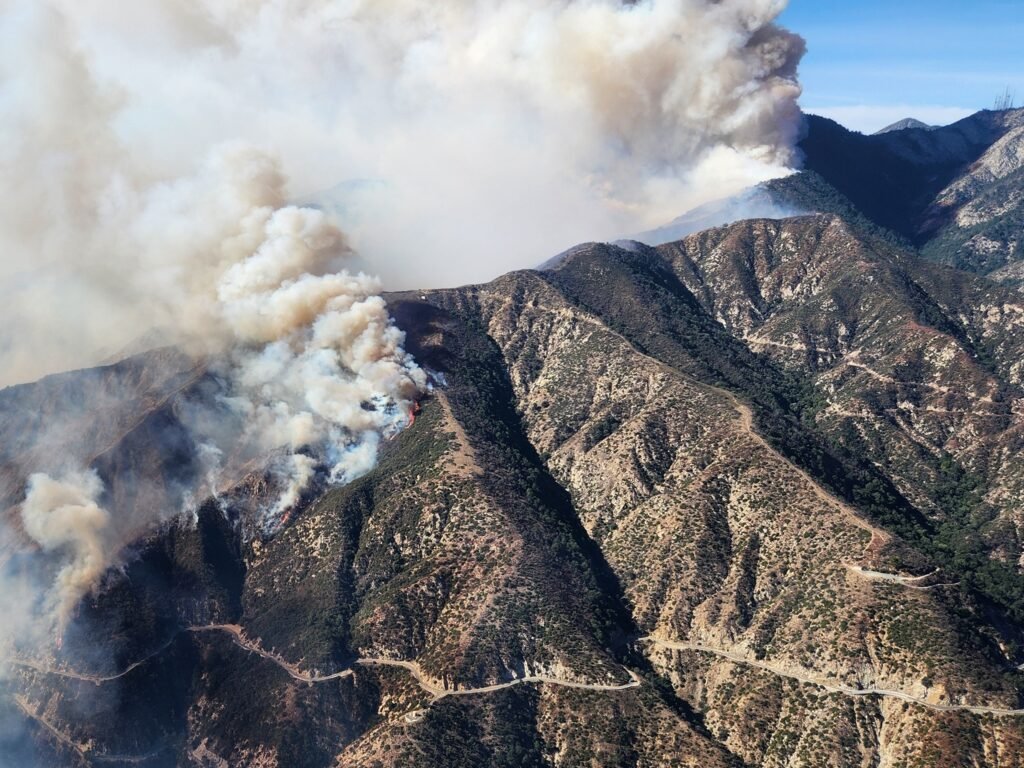
A new analysis of the January 2025 Eaton Fire shows why smoke from burning neighborhoods cannot be treated as ordinary forest-fire smoke. Researchers at the California Institute of Technology found that airborne particles from the urban fire contained more than 50 times as much lead, seven times as much chlorine and bromine, and three times as much arsenic as smoke sampled during a largely vegetation-fueled Southern California fire. Their findings were published October 28, 2026, in Science Advances.
The researchers also estimate that, during the peak period of burning structures, approximately 7 million people in the Los Angeles metropolitan area encountered 24-hour airborne lead concentrations more than 80 times the region’s typical background level. That is a modeled population-exposure estimate—not a count of people diagnosed with lead poisoning, and not evidence that everyone inhaled an identical dose.
Why buildings change the chemistry of smoke
Wildland fires primarily consume vegetation. An urban fire can also burn houses, vehicles, electronics, wiring, paints and other manufactured materials. Those different fuels can change which chemicals enter the air and how far pollutants travel. The Eaton Fire moved through Altadena and surrounding developed areas before advancing into the San Gabriel Mountains, giving researchers an unusual opportunity to watch the chemical signature change over time.
At a monitoring site in Pico Rivera, roughly 11 miles south of Altadena, instruments measured the chemical composition of airborne particles almost continuously. The researchers compared the Eaton Fire measurements with those collected during the September 2024 Airport Fire, which predominantly burned vegetation. Their comparison showed especially high lead concentrations during January 8–9, when the Eaton Fire was burning structures. As the blaze moved toward wildland terrain, the balance of lead and potassium in the plume shifted toward a more conventional wildfire signature.
Two striking numbers, two different comparisons
The headline finding of more than 50-fold lead enrichment compares the Eaton Fire’s urban smoke with smoke from the largely vegetation-driven comparison fire. The separate 80-times-background estimate compares airborne lead concentrations during a 24-hour peak-exposure period with normal Los Angeles-area background levels. These are not interchangeable measures, and neither is a measurement of lead in individual people’s blood.
According to the researchers, standard air-quality reports often emphasize the total mass of fine particulate matter, commonly called PM2.5. That measure is important, but it does not by itself identify the mix of metals and other substances inside the particles. The advanced monitoring network used for this study tracked chemical components at much shorter intervals, revealing peaks that less frequent sampling might miss.
What the study does—and does not—say about health
Lead and arsenic are established health hazards. But the study did not determine how many people developed illness from this particular plume, and the authors say the long-term consequences of brief, unusually intense exposure remain uncertain. Individual exposure would have varied with location, time, indoor conditions and behavior. Readers should not interpret the estimated population figure as a clinical diagnosis.
The findings nevertheless raise an important emergency-management question: should authorities assess smoke from neighborhoods differently from smoke generated mainly by trees and brush? Better chemical monitoring could help public-health officials decide where warnings and protective measures are needed, including communities far downwind of visible flames.
The next test for emergency response
The researchers want the measurements incorporated into models that forecast the movement and composition of fire smoke. One limitation is that the Eaton Fire burned many older structures, so its unusually strong lead signal may not characterize every urban blaze. More monitoring during future fires will be needed before officials can generalize the exact ratios.
Bottom line: The study provides evidence that the source of smoke matters, not just how thick it looks. It strengthens the case for measuring what is in a plume while leaving the actual health outcomes from the Eaton Fire’s short-term exposure an open scientific question.
Sources and image credit
- Caltech, October 28, 2026 — original research announcement and methodology.
- Baliaka et al., Science Advances (2026), “Fire at the boundary: Airborne toxic metals from the 2025 Los Angeles urban firestorm”.
- Associated Press, October 29, 2026 — independent reporting.
- Featured photograph: The Eaton Fire on January 8, 2025, photographed by Matt Muller, USDA Forest Service (public-domain U.S. federal government work). Original image and license information. The image documents the 2025 fire, not the 2026 laboratory study or its measurement instruments.
Video note: No official exact-study video with confirmed upload metadata and embed permission was verified at publication. The original Caltech research page above provides the primary-source fallback.


About The Author





Leave a Reply