Congo’s Ebola Cases Pass 10,000: What the New Count Reveals — and What Remains Unknown
· News Team
Updated October 27, 2026. The Democratic Republic of the Congo has passed 10,000 confirmed cases in its ongoing Bundibugyo Ebola outbreak, according to a government situation report cited by Reuters on Tuesday. The reported cumulative count is 10,060. It is a major threshold in a public-health emergency that has already spread beyond Congo’s borders, but the new total should not be mistaken for 10,060 people currently ill.
What the latest number tells us — and what it does not
Reuters reported on October 27 that the country’s public-health institute recorded 10,060 cumulative confirmed infections. That report did not provide a matching updated death toll, so it would be misleading to attach an older death figure to the October 27 case count as though both were measured on the same day.
The World Health Organization’s October 23 situation report gave a different, explicitly dated snapshot: 9,704 confirmed cases and 4,687 deaths in Congo as of October 20, across 66 health zones in eight provinces. These are cumulative surveillance totals, subject to verification and revision. The numerical difference between the two published case snapshots is 356; it should not automatically be interpreted as 356 newly infected people during that interval because reporting cutoffs and retrospective adjustments can differ.
Why the Bundibugyo strain complicates the response
The outbreak involves Bundibugyo virus, a different Ebola virus from the Zaire species targeted by established Ebola vaccines. The WHO has emphasized the need for surveillance, early detection, safe care and coordinated regional preparedness. In its October 23 update, the organization reported that many deaths were occurring in communities rather than treatment centres — a warning sign for delayed detection and difficulties accessing care.
Researchers are investigating vaccine options, but the existence of trials does not mean a vaccine has been proven effective against this outbreak strain. Nor should readers confuse a cumulative case count with the number of active infections, the pace of transmission today, or a prediction of the outbreak’s eventual size.
Why the regional picture matters
WHO documented imported cases in Kenya and Nigeria in its October 23 report. Imported infections do not by themselves demonstrate sustained community transmission in the receiving country. The US Centers for Disease Control and Prevention said in its October 24 assessment that the risk to the US public remained low, and that no outbreak-related US cases had been confirmed.
Travel and border responses should be grounded in evidence. WHO’s October 23 assessment advised against restrictions on travel or trade with affected countries, while urging stronger detection, contact tracing and cross-border coordination. For the latest practical health guidance, consult local public-health authorities rather than social-media rumours.
What to watch next
The most useful next indicators are the number of newly confirmed cases by reporting date, the share of infections linked to known contacts, the number of affected health zones, safe access to treatment and the timing of official updates. The 10,000-case threshold is newsworthy; whether transmission is accelerating or slowing requires those additional measures.
Related Tectonics coverage: Attacks on Ebola response workers in Congo and Investigation of Nigeria’s imported case.
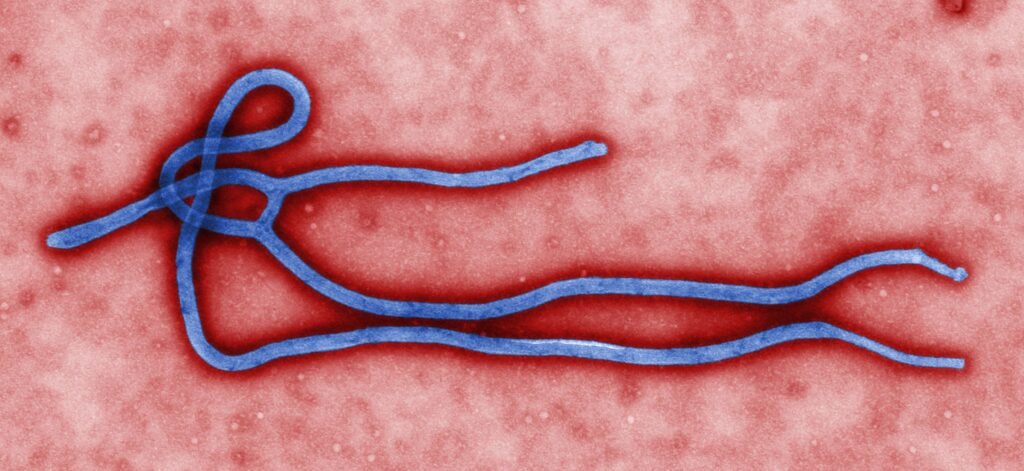
Featured image: Illustrative archival electron micrograph, not from the 2026 outbreak and not a confirmed image of Bundibugyo virus. CDC / Cynthia Goldsmith, Public Health Image Library no. 10816; US government work, public domain. Source and license.
Video note: No independently verified, exact-event official video for the October 27 case-count update was available for embedding at publication time. Older outbreak footage is intentionally not presented as current.
Sources and verification
- Reuters, October 27, 2026: government-reported 10,060 cumulative cases
- WHO Disease Outbreak News, October 23, 2026 (figures as of October 20)
- CDC: Ebola outbreak situation summary, updated October 24, 2026


About The Author





Leave a Reply