Voyager 1 Reconnects After Signal Loss as NASA Races to Preserve Its Power
· News Team
NASA’s farthest spacecraft is talking to Earth again after an unexplained communications interruption — and a separate engineering maneuver could help it keep collecting science data for longer. In an October 29 mission update, NASA reported that Voyager 1’s radio signal returned on October 20 after two missed communications attempts on October 18 and 19. Engineers have maintained contact since, but the cause of the interruption is still under investigation.
What happened to Voyager 1?
NASA’s Deep Space Network could not detect the probe during two scheduled contact windows roughly 24 hours apart. Its signal then reappeared on October 20, before engineers had sent new commands to troubleshoot the problem. NASA said an active group of thrusters had gone offline and backup thrusters had switched on, a protective response the spacecraft can initiate automatically when it detects a problem.
That sequence is important: the thruster switch is an observed clue, not a confirmed explanation for the radio outage. Voyager 1 did not need a newly transmitted Earth command to resume communication, according to the agency’s account. Mission controllers are investigating why the system entered that state.
A power-saving swap buys precious time
NASA also disclosed that in early September its engineers replaced three power-hungry onboard heating devices with three lower-power alternatives in a carefully coordinated operation nicknamed the “Big Bang.” The devices help distribute heat so the spacecraft’s systems can function in deep space. NASA had carried out a similar maneuver on Voyager 2 weeks earlier.
The probes use radioisotope thermoelectric generators that convert heat from decaying plutonium into electricity. Their available electrical output falls by about four watts annually, NASA says. After nearly five decades, even small savings can determine whether a science instrument stays switched on.
Without the Voyager 1 power-saving maneuver, NASA estimated that it might have needed to shut down another science instrument as early as summer 2027. That is an estimate about a future decision, not a guarantee that all current instruments will remain operational indefinitely.
Why November 18 will be historic
The probe is approaching a different milestone. On November 18, 2026, at 5:16 a.m. Eastern Standard Time, NASA expects Voyager 1 to reach a distance of one light-day from Earth — about 16.09 billion miles (25.9 billion kilometers). That is a measure of distance, not a claim that the probe will suddenly travel faster or experience a new physical boundary. NASA’s light-day explainer and mission tracker provide the official calculation.
At that distance, a radio message traveling at light speed takes roughly 24 hours to reach Voyager 1. A response takes another 24 hours to get back. Even when hardware is working perfectly, a complete exchange therefore spans about two days. This extraordinary delay makes autonomous fault protection and careful advance planning essential.
What scientists can still learn
Launched in 1977, Voyager 1 visited Jupiter and Saturn before crossing the heliopause into interstellar space in 2012. It is now among the very few instruments capable of directly sampling conditions beyond the Sun’s protective bubble. Its continued operation gives researchers measurements that cannot be reproduced from Earth-based telescopes alone.
The latest NASA update contains two different kinds of news: communications have resumed, while the reason for the interruption remains unresolved; and an energy-saving intervention may prolong the probe’s scientific life. Neither development means the spacecraft is risk-free. The more distant it travels, the more valuable each working instrument — and each successful contact — becomes.
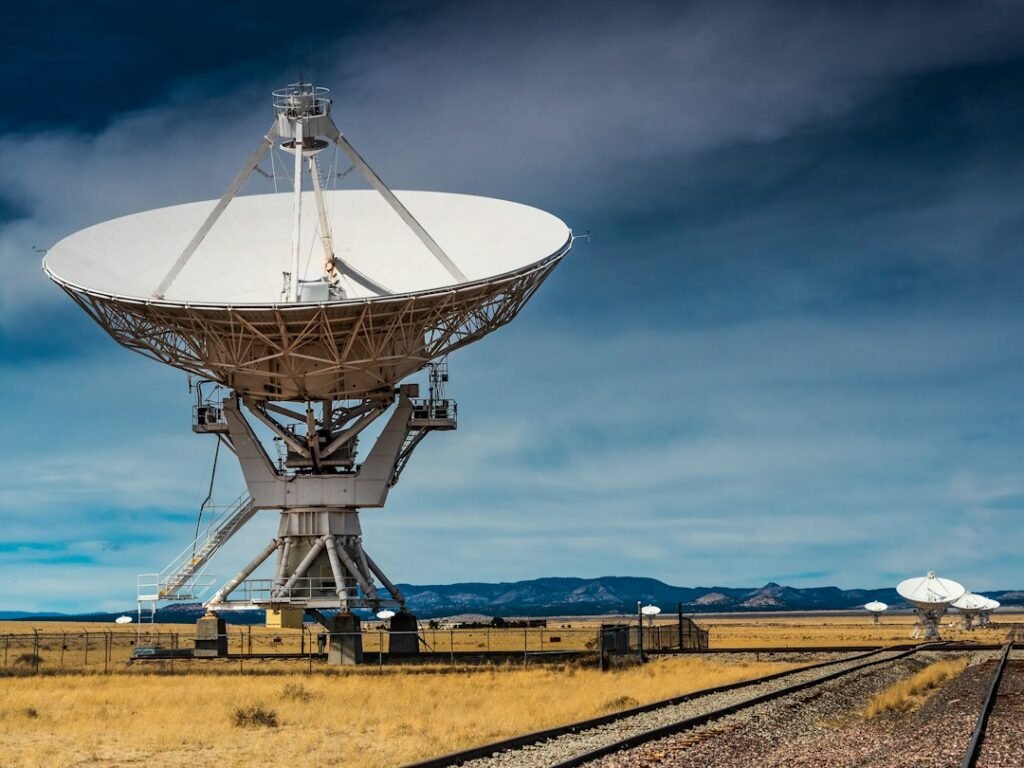
Image: Illustrative photograph of radio telescopes at the Very Large Array in New Mexico, not NASA’s Deep Space Network and not Voyager 1. Photo: Raychel Sanner / Unsplash.
Primary sources: NASA mission update (October 29, 2026); NASA light-day explainer; Voyager 1 mission profile.


About The Author





Leave a Reply