Even Seabirds Get Jet Lag: 20 Years of Tracking Reveal a Hidden Navigation Error
· News Team
A bird can be on the right journey and still read the sky a little wrong. New research tracking Manx shearwaters across the Atlantic suggests that rapid eastward flights temporarily put the seabirds’ internal clocks behind local solar time. Because the birds use the sun as a directional reference, that lag produces small but measurable errors in their flight paths.
The study, published on October 29, 2026 in the journal Science, draws on about two decades of GPS records from 1,045 Manx shearwaters and 3,688 foraging trips. Researchers at the University of Oxford and collaborating institutions compared actual flight directions with predictions based on how the sun’s apparent position changes as a bird moves across longitude.
Why the sun can point the wrong way
Using the sun as a compass is not as simple as flying toward or away from it. Its position changes throughout the day. A bird must therefore combine what it sees overhead with an internal estimate of the time. During a fast flight east, local sunrise occurs earlier than it did at the departure point; the bird’s body clock may take time to catch up.
The Oxford team reports that this mismatch can approach one hour during homeward journeys. In an analysis of 335 flights out of sight of land, observed headings closely followed the deviations predicted by a clock that had not fully adjusted. The researchers also found the expected pattern along coastlines, even where landmarks might have offered another navigation cue.
A measurable error, not a navigation collapse
The study describes compass errors reaching roughly 15 degrees, but that does not mean adult shearwaters routinely become lost. The tracked birds appear able to correct their course as they travel. The researchers calculated that a bird returning from about 1,000 kilometres away with a typical seven-degree error could add only about five kilometres to its route if it keeps correcting its position.
That distinction matters. The research provides evidence of an internal-clock effect on navigation; it does not demonstrate widespread failed migrations, harm to the birds’ health or human-like symptoms such as exhaustion. The possibility of larger accumulated errors in less experienced migrants is a hypothesis requiring further investigation, not an outcome established in these tracked adults.
What the finding changes
The result strengthens a view of animal navigation as a combination of systems rather than a single infallible compass. A seabird may use a map-like sense to establish where home is and still rely on a time-sensitive solar compass to choose a heading. The fact that the predicted deviations persist near visible coastlines suggests that familiar geography does not automatically override the sun cue.
It also offers a way to study biological clocks outside a laboratory. Researchers can compare naturally occurring journeys with astronomical predictions instead of deliberately changing a bird’s clock. Whether repeated clock shifts affect feeding, resting or survival remains unknown.
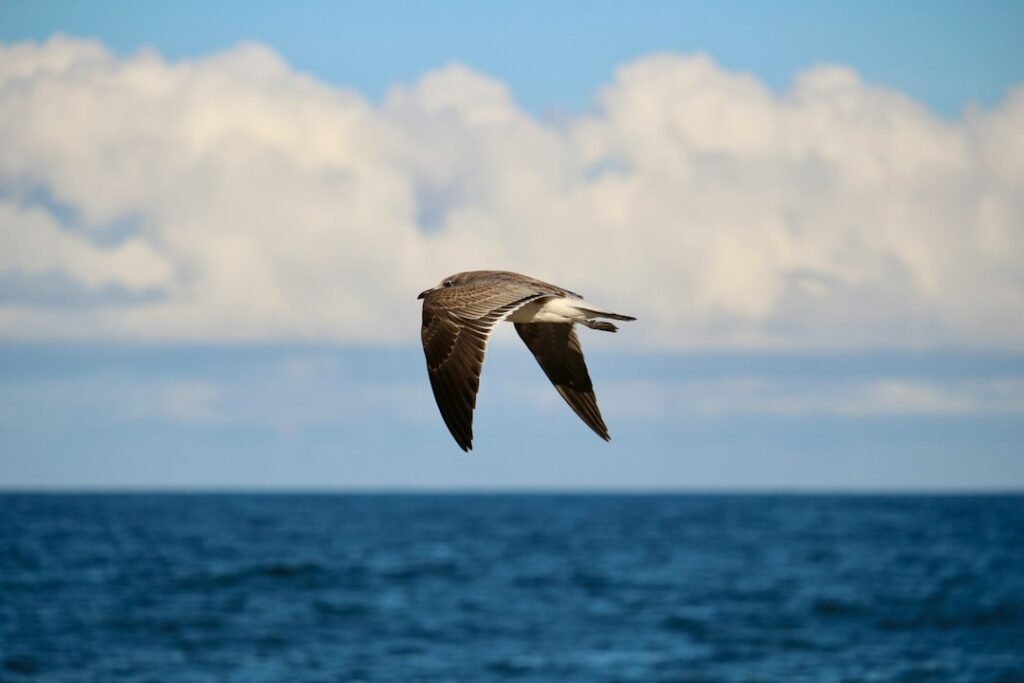
Featured image: illustrative bird over the sea, photographed by Michael Geyer via Unsplash. It does not depict an identified Manx shearwater from the study.
Sources and further reading
- University of Oxford, October 30, 2026 — research announcement and methods summary
- Lewin and colleagues, Science, October 29, 2026 — original research
- Reuters, October 30, 2026 — independent reporting and researcher interviews


About The Author





Leave a Reply