NASA’s Artemis III Will Test Two Moon Landers in Earth Orbit. Why That Matters for 2028
· News Team
October 24, 2026 | Science & Space | Tectonics Media Publications News Team
NASA’s revised Artemis III plan puts Orion through docking and habitation tests with both Blue Origin and SpaceX in 2027. The bigger question is what those tests can—and cannot—prove before a targeted 2028 Moon landing.
NASA has sharpened its roadmap for returning astronauts to the Moon: before attempting another landing, the agency wants a crewed mission in Earth orbit to test the spacecraft partnerships on which that landing will depend. In detailed plans released on October 23, NASA said Artemis III is targeted for 2027 and will involve docking with test vehicles from both Blue Origin and SpaceX. The first crewed lunar landing in the revised sequence remains a 2028 target, not a completed or guaranteed mission.
What Artemis III is actually scheduled to do
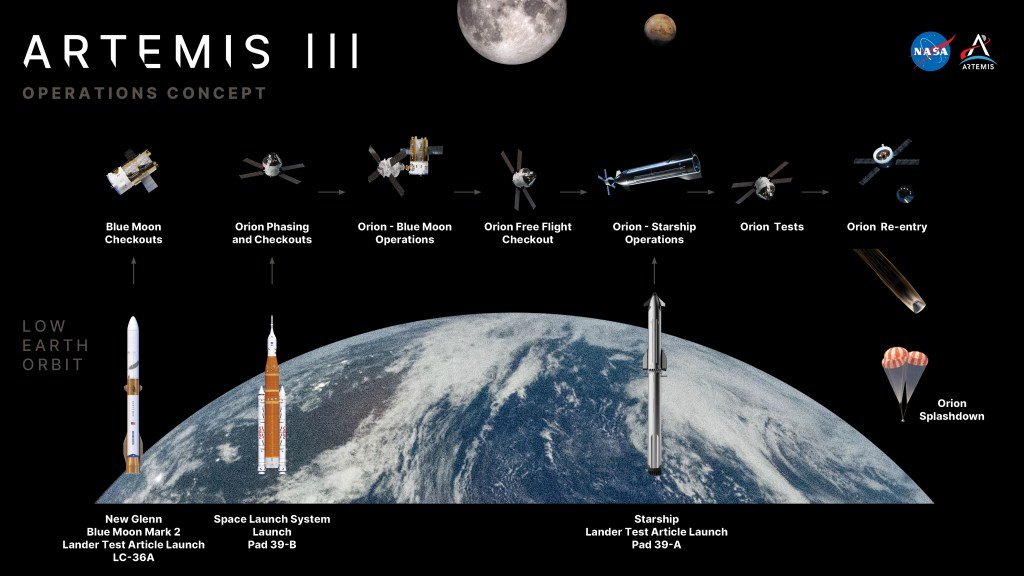
NASA’s October 23 mission description names Randy Bresnik, Frank Rubio and Andre Douglas of NASA, plus European Space Agency astronaut Luca Parmitano, for a planned 14-day Orion mission in low Earth orbit. Unlike the Moon-bound Artemis II flight earlier in 2026, Artemis III is not a lunar landing. Its purpose is to rehearse the delicate sequence of bringing together separately launched spacecraft, transferring people between them and validating systems that cannot be fully tested on the ground.
NASA describes a three-spacecraft campaign involving Orion, a Blue Origin Blue Moon Mark 2 test article and a SpaceX Starship test article. Blue Moon is expected to launch first. Orion would then rendezvous and dock with it; crew members would enter the test vehicle and assess cabin, atmosphere, life-support and operational systems. The mission also includes a separate Starship docking demonstration. NASA says the exact sequence is designed to build evidence for future crewed lunar operations rather than certify an entire landing mission in one flight.
Why the two-lander test is significant
NASA previously assigned specific lunar landing missions to SpaceX and Blue Origin. Under the revised plan, neither provider is guaranteed the first 2028 crewed landing: NASA says it will decide based on readiness. That makes Artemis III more than a dress rehearsal. It is also a way to evaluate whether two different commercial approaches can work safely with Orion, giving the agency more options if one architecture encounters delays.
The difficult part is not simply making spacecraft touch in orbit. Guidance software, communications, docking mechanisms, crew access, environmental controls and coordination between mission-control teams all have to function together. An Earth-orbit demonstration can reveal integration problems while the crew remains much closer to home than on a lunar expedition.
Two very different routes to the lunar surface
NASA’s updated concept calls for SpaceX’s Starship lander to use multiple tanker flights to accumulate cryogenic propellant in Earth orbit. Under the new plan, Starship would meet Orion in Earth orbit and help propel the combined spacecraft toward a low orbit around the Moon. The concept still depends on demonstrating large-scale propellant transfer and successfully flying an uncrewed landing demonstration.
Blue Origin’s Blue Moon Mark 2, by contrast, would defer in-space propellant transfer for its accelerated lunar landing design. NASA describes three transfer stages that progressively move the lander toward an elliptical polar orbit around the Moon. Each approach has distinct operational and technical trade-offs; neither has yet completed the full crewed lunar landing mission NASA intends.
What the 2027 test will not establish
A successful Artemis III would not mean a 2028 landing is assured. Crewed Moon missions still require working launch systems, a certified lander, spacesuits, surface operations, safe ascent from the Moon and a return to Earth. NASA says both lander providers must complete uncrewed demonstrations before the near-term crewed landings. These are substantial milestones, and schedules remain subject to testing and safety reviews.
For readers following the timeline, three distinctions matter: 2027 is the target for the Earth-orbit integration test; 2028 is the target for the first landing; and the selection of the first lunar lander remains open. NASA’s October 23 update is therefore a change in execution strategy, not an announcement that the Moon landing has already been achieved.
What to watch next
The most revealing milestones will be test-vehicle readiness, Orion’s docking preparation, SpaceX’s in-orbit propellant-transfer demonstration, Blue Origin’s integrated hardware tests and the independent safety reviews before crews fly. NASA’s revised architecture could reduce some mission complexity, but its success will be judged by completed demonstrations rather than aspirational dates.
Reporting sources
- NASA, “Artemis III Mission to Test Future Moon Lander Operations” (October 23, 2026; mission crew, test sequence and duration).
- NASA, “Partners Accelerate Lander Development for 2028 Moon Missions” (October 23, 2026; revised architecture and outstanding requirements).
- Associated Press, independent coverage of the October 23 Artemis update (October 23–24, 2026).
Follow more original explainers in Tectonics Science. For help evaluating rapidly changing headlines, see our breaking-news verification guide.


About The Author





Leave a Reply