Wacker Chemie’s Q3 Profit Nearly Doubles—But €35 Million One-Off Clouds the Comeback
· News Team
October 29, 2026 | Munich, Germany. Wacker Chemie reported a sharp recovery in third-quarter earnings on Thursday, but the headline jump does not tell the whole story. The German specialty-chemicals group generated €217.2 million in EBITDA, up from €111.7 million a year earlier, while revenue increased 9.4% to about €1.47 billion. The improvement reflects real cost savings and stronger pricing—alongside a roughly €35 million one-time benefit from terminating a polysilicon contract.
That distinction matters for investors and industrial customers trying to judge whether Europe’s chemicals sector is recovering sustainably or whether restructuring is temporarily lifting reported results. The figures come from Wacker’s October 29 earnings announcement, independently cross-checked with Reuters’ same-day report.
What improved—and what did not
EBITDA rose by approximately 94% year over year, and the reported EBITDA margin expanded from 8.3% to 14.8%. Wacker credited its PACE cost-reduction program, launched in October 2025, as the principal driver. Higher selling prices, currency movements and a more favorable product mix also contributed. All four business divisions posted higher revenue than in the comparable quarter.
But the €35 million contract-termination benefit represents roughly 16% of the quarter’s reported EBITDA. Subtracting that item mechanically would leave about €182 million, still above the prior year’s reported €112 million, but not a company-certified adjusted EBITDA figure or a fully comparable underlying measure. Other moving parts—including currency and mix—make a simple adjustment insufficient to isolate recurring profitability.
The quarter was also not an uninterrupted acceleration: sales were down 3% from the second quarter of 2026, while EBITDA increased only about 3% from the preceding quarter’s €211 million. The year-over-year comparison is strong, yet it does not by itself establish that customer demand has turned a corner.
Why the €476 million cash-flow headline needs context
Wacker reported quarterly net cash flow of approximately €476 million, compared with €19 million a year earlier. However, the company said the result benefited from around €170 million in proceeds from additional sales of its Siltronic shareholding and an approximately €120 million one-time liquidity effect linked to changes in how it secured partial-retirement obligations. These transactions are important for the balance sheet, but they should not be mistaken for cash generated solely by selling chemicals.
Net income was about €87 million, reversing a loss of roughly €82 million in the prior-year quarter. Capital spending fell to approximately €71 million from €111 million, reflecting a focus on optimizing and maintaining existing facilities.
The semiconductor opportunity versus the solar squeeze
Wacker’s polysilicon business serves distinct markets. High-purity material used in semiconductors is supported by demand for computing and electronics, including AI-related infrastructure, whereas solar-grade polysilicon continues to face difficult market conditions. Strong demand for chip-related applications therefore does not imply that every part of the polysilicon business is recovering at the same pace.
Management maintained its full-year sales and earnings guidance, while adjusting its outlook for net financial debt. It continues to target more than €300 million in annual savings from PACE beginning in 2028. Those future savings are targets, not realized 2026 earnings. The company also cautioned that demand in automotive and construction remains subdued and that a sustained economic turnaround is not yet visible.
What to watch next
The next test is whether Wacker can sustain improved margins without large non-recurring gains, while holding prices and volumes in a weak European industrial market. Investors should separate three questions: how much of the EBITDA improvement recurs, how much of cash flow comes from ordinary operations, and whether semiconductor demand can offset continued solar and construction weakness.
Bottom line: Wacker’s turnaround measures appear to be having a measurable effect, but the quarter is better read as evidence of improved cost discipline than as proof of a broad chemicals-industry recovery.
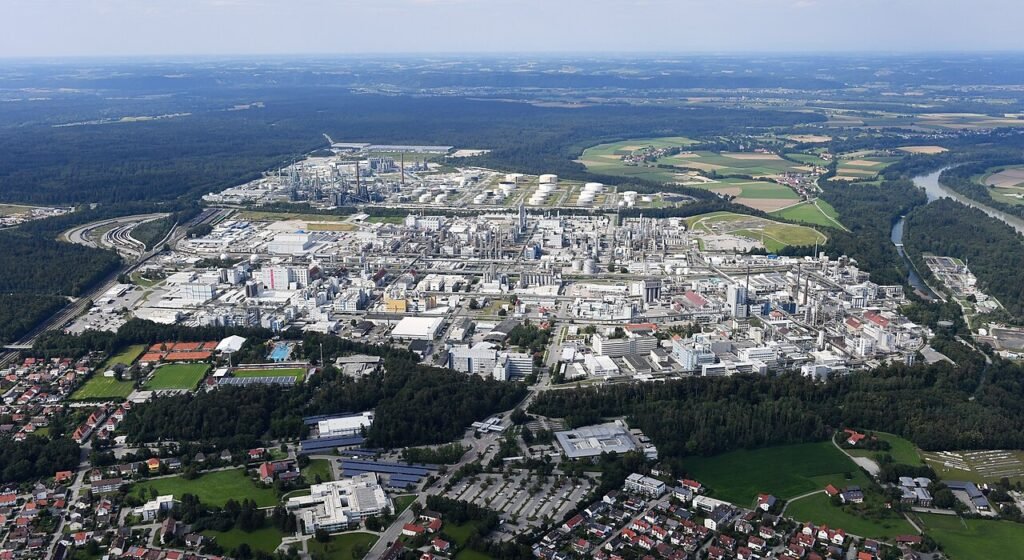
Sources: Wacker Chemie AG, Q3 2026 results announcement, October 29, 2026; Reuters, October 29, 2026. Featured image: Aerial photograph of the Wacker Chemie Burghausen plant, taken July 26, 2024, by Carsten Steger, Wikimedia Commons, licensed CC BY-SA 4.0; used unchanged as an archival illustrative image, not as a photograph of the earnings announcement. No verified event-specific authorized video was available at publication; the official results announcement is the primary-source fallback.


About The Author






Leave a Reply